
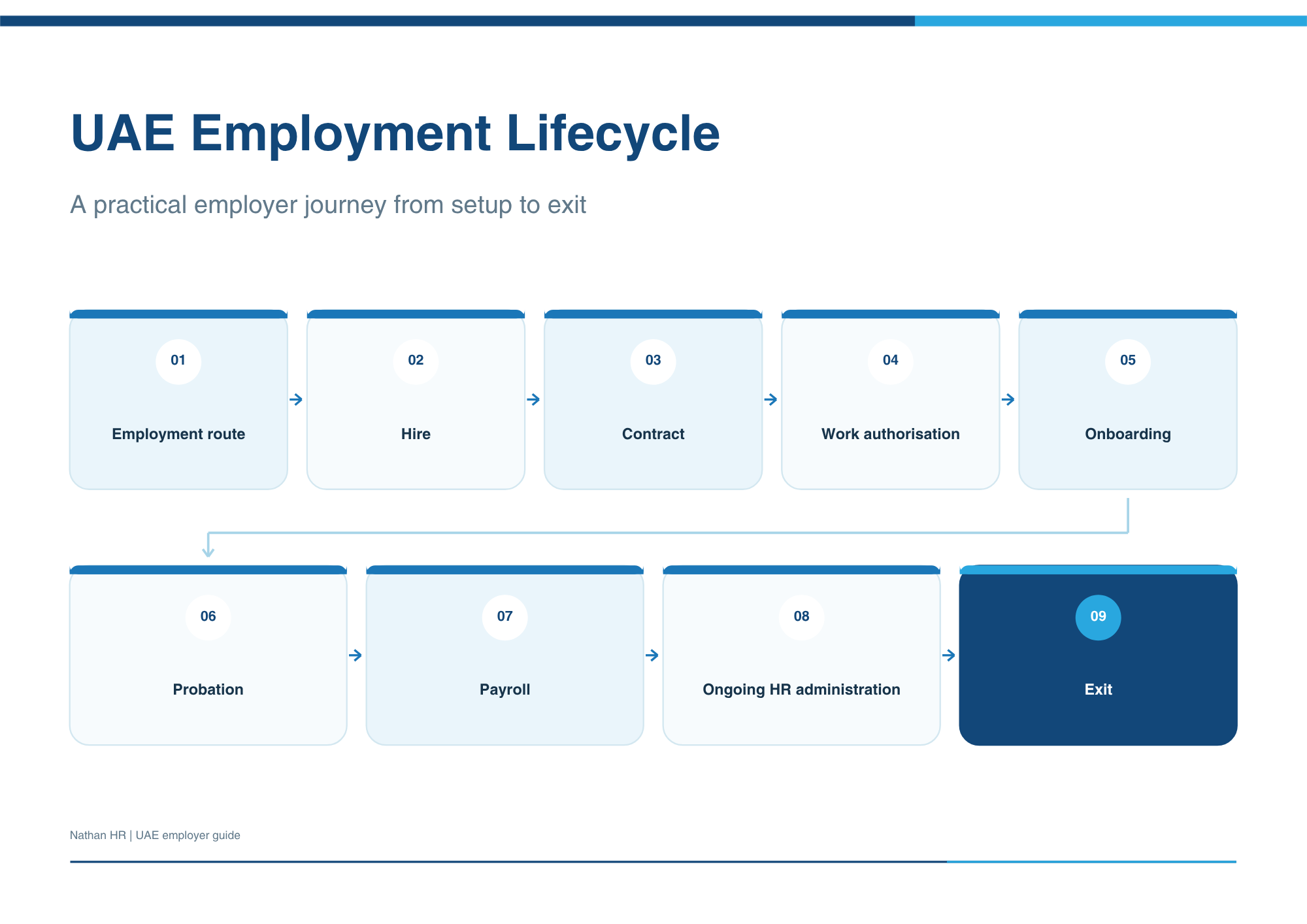
Employing people in the UAE requires an appropriate employment route, a compliant contract, the correct work authorisation, payroll processes and ongoing employee administration. Requirements depend on the employer’s jurisdiction, the employee’s status and the authority responsible for the employment relationship.
For many private-sector employers, Federal Decree-Law No. 33 of 2021 provides the core framework. Free-zone procedures can differ, while DIFC and ADGM operate separate employment regimes.
This guide focuses on private-sector employment. Separate rules govern domestic workers and government employees.
What Does a Business Need Before It Can Employ Someone in the UAE?
Before hiring, a business needs a structure that permits it to engage staff and complete the required labour, immigration and payroll processes.
Direct employment can involve the appropriate trade licence, employer registrations, access to the relevant labour or free-zone authority, immigration registrations and payroll capability. Mainland employers registered with MOHRE follow Ministry procedures, while free-zone employers work with their jurisdictional authority.
Our permanent recruitment services can support candidate identification and selection before employment and onboarding.
Do You Need a UAE Entity to Hire Employees?
A UAE entity provides one route for direct employment. An Employer of Record can provide another structure for eligible workforce arrangements through an appropriately licensed employment model.
A business with an eligible UAE entity can employ staff directly. An international company without its own employing entity can consider an EOR for eligible roles. Under our UAE EOR service, we employ eligible workers while the client directs day-to-day work.
With HR or payroll outsourcing, the client remains the legal employer. Our Employer of Record UAE guide explains the EOR model in more depth.
What Employment Contract Is Required in the UAE?
For employment governed by the federal private-sector framework, the employment contract must be concluded for a definite period and can be renewed by agreement between the parties.
MOHRE procedures apply to establishments registered with the Ministry. Contracts should record the role, workplace, start date, wage, work pattern, term and other agreed conditions.
The UAE Government guidance on job offers, work permits and employment contracts explains the federal process. DIFC and ADGM employers should follow their separate employment regimes.
What Work Permit and Residence Process Does an Employee Need?
A work permit authorises employment under the relevant system. Residence status concerns the employee’s right to reside in the UAE, so the two should be treated separately.
MOHRE provides several work-permit categories. Employer-sponsored residence can involve work authorisation, immigration approval, medical fitness, Emirates ID and residence issuance.
For relevant private-sector cases, the UAE Work Bundle combines several employment and residence procedures. Federal identity and immigration services are administered through ICP, while Dubai immigration processes can involve GDRFA Dubai.
What Should Employers Complete During Onboarding?
Onboarding should combine authority requirements with internal joining procedures.
Statutory and Authority Requirements
Employers should confirm the contract and work-authorisation processes are complete, collect records for payroll and government processing, arrange required insurance and record payroll information.
Internal HR Practice
Internal onboarding can include policy acknowledgements, system access, leave setup, benefits enrolment and employee-file administration. These are internal practices unless legislation or the relevant authority requires them.
How Does Probation Work in the UAE?
Under the federal private-sector framework, probation cannot exceed six months.
If an employer terminates employment during probation, at least 14 days’ written notice is required. An employee moving to another UAE employer during probation must give at least one month’s written notice. An employee resigning during probation to leave the UAE must give at least 14 days’ written notice.
How Should Employees Be Paid in the UAE?
Employees should be paid according to their employment terms and the wage-payment rules that apply to the employer.
For establishments registered with MOHRE, wages must be paid through the Wage Protection System, or WPS, or another system approved by the Ministry, subject to specified exclusions.
Payroll records should capture salary components, approved deductions and supporting information for each pay cycle. Our guide to payroll outsourcing in the UAE explains how external payroll support can work.
What Ongoing Employment Responsibilities Do UAE Employers Have?
Employers need processes for working time, leave, payroll, employee records, insurance and employment changes.
Working Hours, Rest and Public Holidays
Normal working hours under the federal framework are eight hours per day or 48 hours per week, subject to specified exceptions. Employees are also entitled to at least one paid weekly rest day and paid leave on UAE public holidays.
Annual and Sick Leave
Employees who complete one year of service are entitled to 30 days of paid annual leave. Employees with more than six months and less than one year of service accrue two days per month.
After probation, sick leave can extend to 90 days per year of service: 15 days on full pay, 30 days on half pay and 45 days without pay.
Maternity, Parental Leave and Health Insurance
Private-sector maternity leave under the federal framework is 60 days: 45 days on full pay and 15 days on half pay. Eligible parents also receive five working days of paid parental leave within six months of the child’s birth.
Employers need to account for health insurance when sponsoring private-sector employees. Abu Dhabi and Dubai operate mandatory employer health-insurance systems.From 1 January 2025, employers in Sharjah, Ajman, Umm Al Quwain, Ras Al Khaimah and Fujairah became responsible for obtaining the required health insurance when issuing or renewing residence permits for relevant private-sector employees.
Employee Records
Employers covered by the federal framework must retain worker files and records for at least two years after employment ends, as set out in the UAE Labour Law.
Does Emiratisation Apply to Your Business?
Emiratisation requirements depend on the employer’s category, workforce size, skilled-job population and whether the establishment falls within the MOHRE system.
For establishments with 50 or more employees, the published Emiratisation programme requires the proportion of Emiratis in skilled jobs to increase by 2% each year, assessed through 1% increases in each half of the year, reaching 10% by the end of 2026.
Separate Emiratisation requirements have applied to selected establishments with 20 to 49 employees in specified economic activities. The published programme required one Emirati appointment by the end of 2024 and one additional appointment by the end of 2025. Employers in this category should check the latest MOHRE requirements before making workforce decisions.
What Happens When Employment Ends?
Employment ending requires coordination across HR, payroll and immigration.
Under the federal framework, contractual notice for ordinary termination must be at least 30 days and no more than 90 days. Employers should calculate final salary, unused leave, end-of-service benefits where due and other contractual sums, then complete the relevant work-permit and residence procedures.
Outstanding wages, other statutory entitlements and gratuity under this framework must be paid within 14 days after the employment contract ends.
How Is End-of-Service Pay Calculated?
For eligible foreign full-time employees covered by the federal gratuity rules, end-of-service gratuity becomes due after at least one year of continuous service and is calculated using basic salary.
The federal formula provides, 21 days of basic salary for each year within the first five years and 30 days for each year after five years, subject to the statutory cap.
Mainland vs Free Zone Employment: What Changes?
Employment authorities, contracts, work permits, immigration procedures and payroll requirements can differ by jurisdiction.
Mainland private-sector employers registered with MOHRE operate under the federal framework and Ministry procedures. Free-zone employers work with their jurisdictional authority. DIFC and ADGM operate separate employment regimes.
.png)
Should You Manage UAE Employment In-House or Outsource It?
The operating model depends on your employment structure, workforce plans and internal resources.
In-House HR Administration
An established UAE employer with internal HR, payroll and government-relations capability can manage these functions internally.
HR, Payroll and PRO Outsourcing
A business can remain the legal employer while outsourcing selected HR, payroll or government-processing functions. Our HR outsourcing guide explains this model, while our HR outsourcing services and PRO services cover agreed administrative and government-processing activities.
Employer of Record
An EOR uses a different employment structure. Under an eligible arrangement, the EOR becomes the legal employer while the client directs the worker’s day-to-day work.
How We Support Employers in the UAE
Our permanent recruitment, Employer of Record, HR outsourcing, payroll outsourcing and PRO services support different stages of hiring, employment, payroll, immigration and workforce administration.
Need Support Employing People in the UAE?
If you are hiring in the UAE, expanding your workforce or reviewing how HR, payroll and employment administration are managed, we can help you assess the support model that fits your organisation.
Employment requirements vary by jurisdiction, employee circumstances and the authority governing the employment relationship. This guide provides general business information and is not legal advice. Confirm the requirements that apply to your organisation before acting.